 The following interview with Julia Cresswell was conducted by Julian Maddison. Julia and Julian – the interviewer and the interviewee – not only have similar first names, but have followed similar paths, both holding degrees from Oxford University and living in that world-famous city.
Julia Cresswell studied English at St Hugh’s College, Oxford, taking the specialist course in Philology and Medieval Literature, before going on to study for an MA in Medieval Literature and a PhD (an edition of a late 15th-century English translation of a French prose romance), both at Reading University. She financed her post-graduate research by university teaching and working as a researcher for OED, and has continued working in much the same way ever since. As well as contributing as a lexicographer to numerous large reference works, she has some 2 0 book titles to her name, mainly in the field of the English language and mythology. She has taught for Oxford University, Oxford Brookes, and numerous American study abroad college departments including Sarah Lawrence and Stanford.
 |
 |
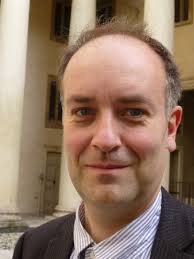 Julian read French and Linguistics at St John’s College, Oxford
Professionally, Julian’s business interests take most of his time; he is the co-founder and co–director of a company which supplies the automotive industry.
However, he continues to write articles covering two of his interests: car design and Goscinny. His work has appeared in various publications in France and the UK and he has been consulted for a number of books and exhibitions related to Goscinny and/or Asterix.
Julian interviewed the late Anthea Bell, a world-famous translator of the French books of Asterix.
How do you set about tracing the etymology of a cliché?
For any etymology, the first stop is always the Oxford English Dictionary. However, OED is not actually that good for collocations (words in groups), rather than individual words, although it is covering them more thoroughly in the new revisions. This is not criticism, simply that OED was set up to trace individual words. Even when it does deal with collocations, it often does not go into their origins. On the other hand, there are lots of other books that will tell you the story behind expressions. Unfortunately, these are often wildly imaginative folk-etymologies – Michael Quinion’s P.O.S.H. devotes a whole book to folk etymologies, many of which are widely believed. The title comes from the belief that the word ‘posh’ comes from the initials for ‘Port out, starboard home’ which was supposed to be on tickets allocating cooler cabins on P&O liners to and from India, although the shipping company has always denied that such tickets ever existed, and no evidence has been found to support the claim. Quinion’s World Wide Words (www.worldwidewords.org is a reliable source on information on both folk etys and true derivations, and on language in general. Luckily, many clichés are pretty transparent – ‘a spanner in the works’, ‘grind to a halt’ are quite clearly about machines in their literal sense. The task is then to find out how old they are, and when they come into general, metaphorical use. Those that do not have an obvious origin are often hidden quotations. I was very pleased with myself over my research on the term ‘crowning glory’ for female hair. At the time OED’s first quote was very odd, as it was from James Joyce’s Ulysses (1922). This was quite obviously an unlikely source of a cliché, so I searched through newspaper archives, and sure enough found an advert run in The Times, and no doubt elsewhere, from 1919 for Rowland’s Macassar Oil, claiming it would make a woman’s crowning glory more glorious still. I left it there, satisfied, as I knew from previous experience, working as a researcher for the Oxford Dictionary of Modern Quotations, that Joyce liked to incorporate adverts into his prose. Checking up, I see that OED’s revised entry has a headline from an American newspaper of 1893 for this use, and has dropped the Joyce quotation – but I’d still bet there’s an advert somewhere behind it. Sometimes, finding the origin is just a matter of luck. I spent years tracking down ‘Live Fast, Die Young’. At the time it was not in any dictionary of quotes or phrases that I could find and nor was its source then findable on-line. In the end I took to raising the matter with anyone I thought might know, and sure enough, an elderly American friend said his evening class had just been studying the novel it came from! Yet again, although I upped the OED at the time of writing, its vast resources have turned up an earlier example than the one I found, but they still miss the key quote that turned it into a cliché via the film of a novel, both called ‘Knock on Any Door’.
Would it be correct to say that there are in effect two etymologies to a cliché? There is the origin of the metaphor and then the start of its widespread use and possible shift from literal to ironic use.
I would say this is a matter of tracing the history, rather than the etymology. As I said above, the actual etymology is often quite obvious, but the transitions you describe less easy to follow, particularly as the different states co-exist, certainly in different people’s speech, often in one’s own, depending on context.
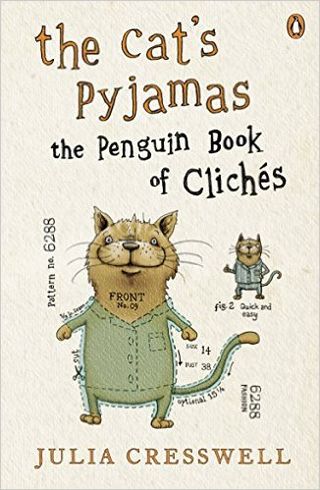
The Cat’s Pyjamas is dedicated to the “broadcasters, journalists and politicians who have made this book possible”. If they are mainly responsible for using clichés is it the case that clichés are more widespread in the modern world than ever before?
A difficult judgement to make, as so much of the evidence is lost, and what survives mostly unknown to me. Given that most of what survives from the past, or at least most of what I am likely to have read, is literary, the language is likely to be more consciously artistic than everyday speech. Certainly Shakespeare uses clichés, both for his ‘man in the street’ language and in his elevated characters (and Venus and Adonis is pretty-well solid cliché ) The same can be said for the medieval literature that has been my other area of study, although academics may prefer to call them tropes or topoi. This is because clichés can be very efficient means of communication – I explain more about this in a piece I wrote for the British Journalism Review now on my website at http://www.juliacresswell.info/lets_hear_it_for_cliches.html . So no, I would guess that clichés are not more widespread than ever before.
Your book gives examples of clichés according to discipline. Apart from sport and politics which areas of life are especially prone to cliché?
The military love clichés (again efficiency comes in here) and a lot of them derive from the world of work, although it can be difficult to differentiate between cliché and jargon. So much depends on the context in which language is being used. If you listen to your own exchanges, you will find that polite conversations with strangers are full of clichés (platitudes, you might prefer to call them) which you would never dream of using in a carefully considered piece of prose.
How do you define the difference between a cliché and a frequently used metaphor?
This is one of the most difficult questions to answer. I spend much of the introduction to The Cat’s Pyjamas wrestling with it. One way of looking at it is that clichés do your thinking for you. I cite as an example a journalist who unthinkingly writes of ancient giant kangaroos that once ‘walked the earth’ when everyone knows kangaroos hop. This is just bad writing, but the unthinking response becomes dangerous when it involves terms such as ‘hearth and home’, ‘this great nation of ours’ and all the other phrases loved by rabble-rousing politicians. However, it has to be admitted that it all comes down to personal judgement. Incidentally, I do not consider ‘the cat’s pyjamas’ to be a cliché, which makes the book’s title a source of some embarrassment. A designer came up with a cover that the editor loved and insisted on using, and I then had to go back and add appropriate text to the book. Not an unusual thing for a professional writer, in my experience.
You must monitor the potential for contemporary phrases to become clichés. Are there any examples that were widely used for a short time but fell out of use before they could become a cliché?
Yes. I was very pleased with myself for spotting the start of ‘not fit for purpose’ (23 May, 2006, John Reid in the House of Commons). The trouble is that such expressions tend to fall off my radar too (judge for yourself if that is a cliché). One much in the papers in the last few days is ‘dog-whistle politics’. This was new to me, but OED has it from 1995 and Wikipedia (which we all have to use sometimes) takes it back to 1988 in the language of opinion pollsters. I suspect that it is quite well established in the idiolect of politicians and their cohorts, but it will be interesting to see if it now spreads to the general population. At the moment I would guess not as its meaning is not terribly obvious , but we shall have to see if usage is reinforced by future events.
Are some languages or cultures more prone to clichés than others? How does the English language compare to other languages?
We have already seen, above, that there are certain cultures where clichés are common. I’m not sure I am qualified to answer about other languages. The only other language I know at all well is French, and being of a generation that was taught to read Racine but not how to order a beer, my colloquial French is not good. Certainly, Medieval French, which I know best, is full of clichés; they are in classical Latin, and students I have taught who are fluent in other languages have no difficultly coming up with examples, so I would guess all languages find them useful.
What cliché do you use the most?
Hmm. I don’t think I would use them if I was aware of it. I just asked my husband, and he says he will listen and see!
Based on this answer and that you talked about “bad writing” earlier would I be right in thinking that you think clichés are always best avoided in speech and writing?
My usual stance is that cliché can be a useful and efficient means of communication. For example the phrase “run for your life” used in a television drama is probably bad writing but it could be a very useful warning in a real life event such as a tsunami. Terry Pratchett wrote that “The reason clichés become clichés is they are the hammers and screwdrivers in the toolbox of communication” and I would agree with that. Clichés become dangerous when they are used to influence thinking and distract people from reality.
Are you working on any linguistic projects at the moment?
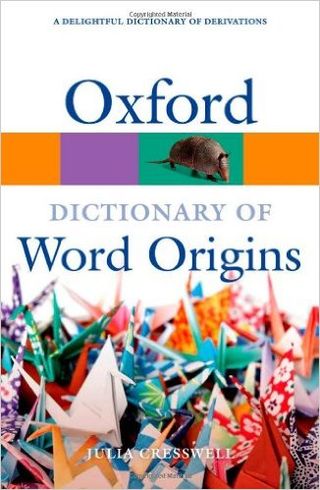
I’m pretty well retired now, so not working on any book at the moment. The last two books I wrote came out in 2014. One was mainly aimed at teenagers, on Charlemagne and his Paladins, dealing with the history, but mainly with the medieval legends. The other was the Little Oxford Dictionary of Word Origins, a pocket-sized reworking of my earlier Oxford Dictionary of Word Origins. I’d be quite happy to do another language book if anyone wanted me to do one, but chasing after publishing contracts in this field has become a difficult task in a world where everything you need is available on-line (which I love), so I have decided not to chase. I have always done a certain amount of university level teaching, particularly of the history of English and medieval literature, and a still do a little of that, including teaching a course on the history of English on an Oxford University Department of Continuing Education summer school called The Oxford Experience every year.
Cet entretien est accessible en français ici. Traduction Jean Leclercq.